My piece for Australian Geographic:
ALAN WADDELL STARTED walking the streets of Sydney three months after the death of Marge, his wife of 60 years. Throughout his years of quiet wandering, Alan documented every street of every suburb in Sydney, in the process photographing the quirky and the mundane – in many ways echoing another pedestrian, William Francis King, 1807-1873, better known as the Flying Pieman.
Now, both men’s lives – Alan, who died in 2008 and William, who died in 1873 – will be documented by new website, Obituaries Australia (OA). The site forms part of a developing resource that, for the first time, lifts the lid on the lives of thousands of Australians, ordinary and extraordinary.
From First Fleet convicts to World War I nurses, the online database, launched by the National Centre of Biography at ANU, aims to fill the biographical gaps in Australian history with a little collaborative help from the public.
“The public is sitting on all this material, which has never seen the light of day,” says historian Professor Melanie Nolan, head of the National Centre of Biography. “It’s very exciting – [the database is] a storehouse for families and an amazing phenomenon for Australians.”
Intended to sit alongside the treasured Australian Dictionary of Biography (ABD), it’s hoped Obituaries Australia will compliment the dictionary’s painstaking scholarship and boost representation of minority groups in the annals of national history.
“In the past, people have relied on mainstream newspapers [to find obituaries],” says Melanie. “We are very aware that we want to pick up what are described as ‘missing people’.” In particular, the lives of women, Aboriginal people, the working class and the Irish are poorly represented in the ADB which, for the last 50 years, has documented the lives of nearly 12,000 prominent Australians.
Capturing lives
Obituaries Australia takes inspiration from the 300,000 old-fashioned index cards that formed the old biographical register (which helped to identify future subjects of the ADB), and heralds a new era, “giving obituaries an honoured place in a wider arena,” says Melanie.
Capturing and sharing the stories of “lives that shaped Australia’s history”, the site will include all published obituaries – whether they have appeared in newspapers, journals, or the like – but it also hopes to commission and collate more life stories, particularly to share lesser-known Australian experiences and more recent deaths.
“You’ve got to be well and truly dead to get into ADB, but you don’t have to be quite so dead to get into OA!” says Christine Fernon, online manager of the NCB, whose enthusiasm for the project is infectious. There’s still only a minute 0.1 per cent chance of making the cut for the ADB, but the new OA site will increase the number of obituaries for ordinary Aussies.
Already, 1,500 obituaries have been uploaded and Melanie admits the team is “in for the long haul.”
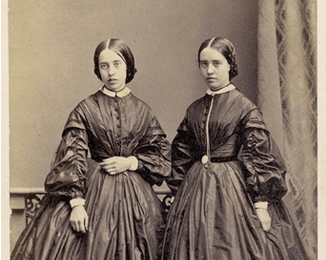
A favourite obituary of hers is that of Saidee Stephens, (1844-1934, pictured above). One of 18 children, Saidee was “a quite brilliant woman who spoke and could read five languages,” Christine says. “If she were alive now she’d be the head of a company or a government department, but back then she didn’t have many choices.”
“So devoted to [her father] was she, that she taught herself how to copy his atrocious writing so that she could take care of all his correspondence for him.” The family tree is meticulously indexed, giving some idea of the interconnectedness the Obituaries Australia site is hoping to tap into.
Or, take the case of James Bloodworth, the oldest obituary captured. A member of the First Fleet, James was sentenced to seven years’ transportation in 1785 for stealing one game cock and two hens in England. His obituary was first published in the Sydney Gazette on 25th March 1804.
Putting faces to stories
The ‘mega-database’ will not only put faces to moments in history like these, but will also widen the centre’s already enviable reach. By next year, the team aims to have more than 12,000 obituaries online, matching the entire 18 volumes of the ADB.
Melanie is excited by the democratic and inspirational potential of the project. “Biography is a medium through which to interest people – it brings people alive,” she says. “People are really attracted to reading about other people’s lives; it’s about coping, interest and learning.”
Her words ring true to Alan’s son John, who is touched by his father’s inclusion. “It’s very special – he was very special to us. To have that memory in permanent form means a lot to us.” John’s family later learnt that if he hadn’t walked the streets of Sydney with such dedication, he would likely have had his legs amputated. The constant fitness regime kept him – and now his spirit – alive.
“I don’t think it matters if [an obituary is from] 200 years ago – the people you respect are those who made the world a better place in their lifetime,” John says. “Any time we feel down we can go to the website and read what people have achieved – it gives you a sense of the wonderful people that were around,”
John hopes his father’s obituary will inspire others. “The only disappointing thing is that Dad couldn’t read it.”
Read the AG version here.
Pic of Saidee Stephens and sister thanks to the State Library of NSW.



 daisydumas.com