Portfolio

Sydney’s 5 most inventive coffees, CNN // 13 June 2011

Read my piece over at CNNGo.com here

It’s coffee, just not as you know it, by Daisy Dumas

There’s something unexpected brewing in Sydney’s café core – and it’ll change the way you look at coffee forever.

Far away from the espresso-based Flat White debate, a group of dedicated baristas are doing their best to prove there’s more to coffee than meets the caffeine-dependent eye.

The humble bean is undergoing a renaissance. Sydney is waking up to aromatic varietals, roasting techniques, alternative brewing methods and — shock, horror — a cup o’ Joe without milk.

From coffees that fizz to fiendishly complex roasting profiles, every cup of coffee tells a tale — and it’s worth putting down your latte to listen to the story.

Here’s the five best alternative cups of coffee in Sydney. Try them and get wired in the process.

1. Sparkler at Coffee Alchemy

Coffee

Cold coffee on tap from the coffee alchemists.

Not for nothing have the espresso-based coffees at this purists’ haunt garnered a fan-base of semi-religious fervour. The game here is coffee and coffee alone, with no food served. And, living up to their name, the alchemists here have been busy experimenting.

Just when you thought things couldn’t get wilder on the caffeine-o-meter, Hazel and the guys at Coffee Alchemy go and invent sparkling chilled coffee on tap.

The south side café is the only place in the world where you can try the sensory-bamboozling drink, the Sparkler ($6). It’s like a beer, but instead of wobbliness, delivers a fizzy hit of caffeine straight to the bloodstream.

Made using a specially selected Ethiopian Nekisse, which is roasted heavily to give it stout-like clout, its chocolaty notes and strong citrus nose add to this bizarre, brilliant and altogether worth-a-try experience.

It’s also poured over ice, making it a predicted hit in warmer months.

Coffee Alchemy, 24 Addison Road, Marrickville, Monday to Friday 7 a.m.-2 p.m., Saturday 8 a.m.-3 p.m., +61 (0)2 9516 1997, www.coffeealchemy.com.au

2. Filtered La Esmeralda at Mecca

Coffee

A pilgrimage to Mecca unveils the art of alternative coffee.

If there is one thing Paul Geshos — owner of this caffeine-pilgrim’s shrine in Ultimo — doesn’t know about coffee, it is unknown.

As well as cupping and brewing demonstrations, Mecca offers some serious coffee lovers’ nectar, such as the rare La Esmeralda ($6), an Ethiopian Geisha varietal that is grown in Panama.

It’s filtered with bells-and-whistles wizardry, producing a clean cup of black coffee — allowing the bean and the bean alone to do the talking.

To heighten expertise, compare it to another variety of filter coffee from the seasonally changing menu. The Colombian Cup of Excellence, for example, is one of the most sought-after coffees. You could start to sound like a pro, picking out top notes of citrus, jasmine and bergamot and ending with a sweet, refreshing finish.

It’s hot, it’s in a cup, it’s called coffee: but that’s where the association with a latte ends.

Mecca, 646 Harris St., Ultimo, Monday-Friday 6 a.m.-4:30 p.m., Saturday 6 a.m.-4 p.m., +61 (0)2 9280 4204

3. Pour-over at Don Campos

Coffee

The magical coffee that changes coffee as it cools.

This new outpost of the Campos empire — Don Campos — is a bright, airy space partly dedicated to the art of alternative brewing. Siphons and pour-overs put subtler shades of coffee into the limelight. They focus on the lightly roasted and constantly changing seasonal varietals.

It’s technical stuff: weighing scales, thermometers, glass funnels and a metal filters. In a nutshell, don’t try this at home — although all the wares are here to buy.

As Don Campos’ coffee cools, it changes character — the El Manzano (apple tree) from El Salvador ($4.50) has an appropriately apple-like sharpness and intensifying, sprightly zing.

It’s a flavor journey that would, frankly, take a wrong turn with the addition of milk or sugar.

Don Campos, 21 Fountain St., Alexandria, Monday-Friday 6:30 a.m.–3:30 p.m., Saturday-Sunday 8:00 a.m.–4:30 p.m., +61 (0)2 9690 0090

4. Cupping at Campos

Coffee

The wooden stairs take caffeine connoisseurs to the art of cupping.

While the slavishly addicted fill the cosy room downstairs, others head up the wooden stairs for an assignation with a difference.

Knock on the wooden door and a hatch slides back. The door opens onto a dark room where spotlights shine onto six cups, six glasses and six small trays of green beans.

Being part of a cupping session ($11) is a rare journey into the selection, judging and global trading that industry insiders know.

Cupping’s an uncompromising system involving smelling, timing, crusts, peeling and slurping at speed from a soup spoon. Like a tribal peculiarity, the louder the slurp, the better — you’ll only stick out if you don’t practically inhale your coffee. Thankfully, spittoons mean you don’t end up bouncing off the walls.

Work your way through the varieties, from floral Ethiopian Lekempti to Indian Monsooned Malabar and Kenyan Gethumbwini – and see if you can spot the supermarket brand.

Campos, 193 Missenden Road, Newtown, Monday-Friday 7 a.m.- 4 p.m., Saturday 8 a.m.-5 p.m., +61 (0)2 9516 3361, www.camposcoffee.com

5. Single Origin’s Sideshow

Coffee

Sideshow is part laboratory, part theater.

The offshoot of wildly popular Single Origin, the aptly-named Sideshow next door is all about educating the discerning coffee drinker — and gives them more than they bargained for.

Apparatus that wouldn’t look out of place in a science lab is lined along the counter: pour-overs, suitably showy cold-drip apparatus and the stars of the show, vacuum siphons.

Pick a single origin from the menu — such as the Rwandan Rutsiro ($5) — and watch the theatricalities unfold as barista Charles unleashes the Japanese siphon technology.

The results are impressive: smokiness and lime shine through and sweet carrot notes strengthen the coffee. Brewed at a high 94 C, it cools in the specially hand-blown glasses.

On a hot day, try a cold-drip coffee over ice ($3) — it’s sweet and clean tasting with a nuttiness that has those in the know addicted.

It’s coffee, just not as you know it.

Single Origin’s Sideshow, 52-58 Reservoir St., Surry Hills, Monday-Friday 7:30 a.m.-2:30 p.m., +61 (0)2 9211 0665

Standard
Blog

The Perilous Reef, feature story // 7 June 2011

THE PERILOUS REEF

Three screens are flashing images of blueness at me. Blurred smudges of azure, navy, royal and aquamarine are punctuated by snatched glimpses of fins, smatters of pink, smears of bright yellow and the white fuzz of foaming water.

I’m in the BBC’s Far North Queensland editing suite near Cairns – a windowless, empty room besides the bank of computers ahead – and series producer James Brickell has sat watching the stream of moving images for a solid eight hours. Where my untrained eye sees montages of colour and watery action, James sees minutiae of the natural world: a coral polyp unfurling, a feather star feeding, a fish cleaning a shark.

The room – the antithesis to the material we’re watching – is not a far cry from those in James’ usual work environment, the tardis-like halls of the BBC’s Natural History Unit in Bristol. From those Georgian buildings, he has worked on some of the most talked-about crowd pleasers in the NHU’s history, including Really Wild Show, Big Cat Diary and Wildlife on One and is quietly famous as the series director of hit children’s show, Deadly 60, and producer of Attenborough’s Life in Cold Blood’s ‘Snakes’ episode. From rappelling into ‘hellish’ caves in Borneo and having his hand lacerated by piranhas in the Amazon, to confounding scientists by filming never-before-seen jumping snakes in Singapore and working with naturalist and ‘living icon’, David Attenborough, James has seen more than his fair share of the extraordinary.

The location, though, is what makes this project so special. Not far from here, beyond the lazily leaning palm trees, vinegar-stationed beaches and shark baits lies the Great Barrier Reef – the subject of the BBC team’s project and the single most challenging story James has ever been asked to declaim. Never before has a ‘blockbuster’, big budget, comprehensive series about the GBR been made and the story has never been riper for telling.

The rub – yes, even in paradise, there is a rub – hinges upon logistics and the all-pervading infectious air of concern from scientists and those who know the reef best: the Great Barrier Reef lies precariously on a knife-edge, teetering between survival and irreversible destruction.

A national icon, a World Heritage area, an internationally renowned tourism honeypot and a ‘natural wonder of the world’ – no wonder the GBR, the world’s largest reef, is held so close the hearts of so many Australians.

“Everyone feels ownership of the reef. It’s an object with a personality – albeit a very big object with a very big personality. Everyone I’ve met, from dive operators to marine biologists to tourists want us to do really well. I feel a huge responsibility to tell the truth about what is happening to the reef – that weight of responsibility to those people is a new thing for me” James tells me. “I want to show the reef at its best so the world can see it’s most dramatic, beautiful, violent, awe-inspiring best.”

Easier said than done.

At nearly £1 million per episode funded by the BBC, Channel Nine and the Discovery channel, the three-part Great Barrier Reef series’ production is a global affair. 19 natural history and production experts, all leaders in their fields, come from five different countries and Brickell and his family have been plucked from England’s West Country and posted to Far North Queensland for a full year.

No stranger to capturing the raw, chaotic beauty of nature on film at the behest of the elements, filming the GBR has been an eye-opening experience for James’ team.

“When you make a wildlife film you’re trying to control as many elements as you can” he says. “You can do your best research but ultimately you can’t control animals and you can’t control weather. In the sea, you’re dealing with light, tides, lunar activity, weather, swell, currents, underwater equipment, access, restrictions, park authorities, seasons”, and, let’s not forget, the wettest Queensland spring on record. “Just to get a cameraman into clear water in good light with minimal currents, no waves and with the animal behaving well – that is very, very rare. Most of what I do is a compromise. The camera breaks, the light changes, the animal won’t cooperate, the swell changes. There are many, many more ways a shoot can go wrong than go right.”

The technological wizardry alone is bigger, better and more unique than anything that has gone before. Whole pieces of submersible kit have been invented to allow the team to reach as far as possible beyond the usual horizons of ocean cinematography.

Richard Fitzpatrick, marine biologist, principal underwater cameraman and the team’s resident shark expert – or as James put it, “basically a walking encyclopaedia of the GBR” – has built an underwater ultra-high speed camera that, as a world first, allows the team to record, store and review footage underwater.

A Cineflex camera – unusual in natural history filming, but at home in Hollywood – has been hired, according to James, at “crippling, eye-watering expense” and means that the team can document the whole reef from the air, capturing ever-elusive natural shots of animal behaviour.

Dealing with tiny depths of field is part and parcel of the rigours of natural history filming. An almost imperceptible 1mm movement of an immensely rare tropical sea dragon, for example, throws footage of the delicate creature entirely out of focus. In the end, it took 120 minutes of footage to produce what will eventually form a 1-minute clip in the film. The feeding sequence the team sought took just three frames of a 600-frames-per-second-clip.

Using specially-adapted remote cameras, it took two weeks to capture a usable shot of a dwarf Minky whale (incidentally thought to be the only whales to seek human contact) swimming next to the reef. The cameras, attached to rocks, recorded more than 100 hours of footage and yielded just five seconds of action.

“Painstaking, involved and without instant satisfaction,” James says the specialist time-lapse photography of the reef has, thankfully, allowed the team to show coral as a metropolis, a cityscape through which fish travel on ‘super highways’.

“To be able to visualise the life of coral in a way that’s never been seen before and using all the technologies we have available is truly astounding.” James tells me. “The reef is like a city in every way – all the bizarre creatures that have different functions on the reef. There are cleaners, builders, gardeners, demolition experts and a vast range of hunters – every creature has a different job and a different niche in which to survive. You get these weird marriages of convenience where two or three animals live in a partnership in which both a key to the success of the partnership.”

Coral itself could not survive without the symbiotic relationship it has with zooxanthellae algae. Rising levels of seawater acidification and sea temperatures can destroy this relationship and the coral bleaches, or dies, without the algae.

“Our experiments have ranged from utter disasters to absolutely stunning footage” James admits. The team has filmed, for the first time, a gall crab’s bluffing survival tactics. They’ve seen Christmas tree worms unfurling and crabs with anemones attached to their claws.

“The reef has a Jekyl and Hyde personality. It changes at night, sounds and sights alter and the whole cast of characters changes completely. It’s a beautiful city with a dark underbelly. I think it’s a miracle that any fish survives 24 hours on the Great Barrier Reef. Of course, they do survive because they all seem to know their place.”

Something, perhaps, we, as custodians of the reef, could learn from. It’s no secret that the GBR – almost flush with sugar cane plantations, sitting in slowly acidifying water, at the mercy of climate change, commercially fished and on the pathway of liners from SE Asia – is under threat. Indeed, renowned reef expert, Dr. Charlie Veron, maintains that coral reefs will be a thing of the past in just 50 years’ time.

James’ children have swum with lemon sharks, scrambled through dense rainforest and played with stag beetles the size of limes during their humid Australian break from Bristol. By the time the reef is expected to perish, they and their peers at the local infant school, where outings to the beach are the norm, won’t have yet turned 60 years old.

It’s clear that the GBR’s loss – and the hole it would leave in its wake – is too much for most to accept. The series, due to air in 2012, is hoped to educate as much as inspire. No mean feat. Still, Brickell shrugs and smiles, “It’s business for me.”

He shows me a freshly edited promotional clip, bursting with the perilous beauty of the reef. It speaks volumes. The production taking shape in this quiet BBC outpost is both a call to arms and a salutary lesson: all this, one day, could be but a film.

Technological wizardry at work in the Coral Sea.

An elusive Minky whale makes a rare appearance.

Setting up a time-lapse camera to capture the night sky above the GBR.

Wearing wet-weather gear on a bright sunny day – for sunburn as much as dryness.

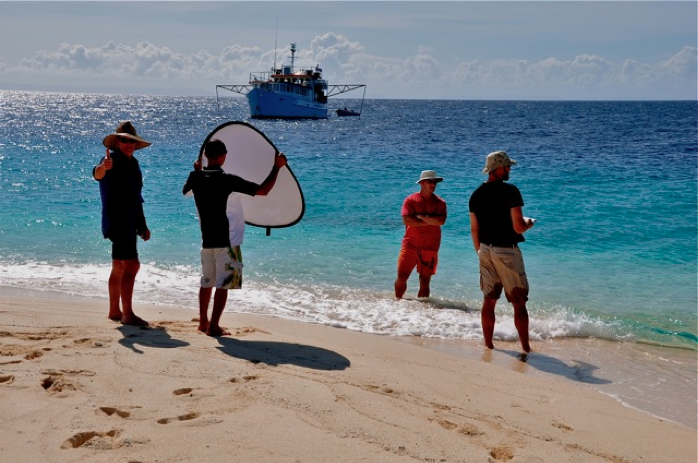
Most footage came from never-before-filmed outposts of the reef.

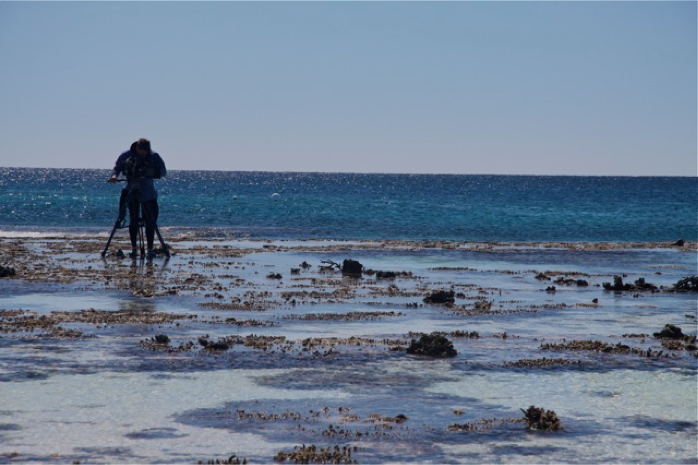
Walking on water, not a bad day at the office.

An elegant black tipped reef shark in his home territory.

James – lover of all things feathered, furred and finned – and his mate the grouper.

Corals, creatures, colours and patterns merge and reflect.

Waiting for the perfect shot can take many an air tanks – 100 hours yielded just 5 seconds of Minky whale footage.

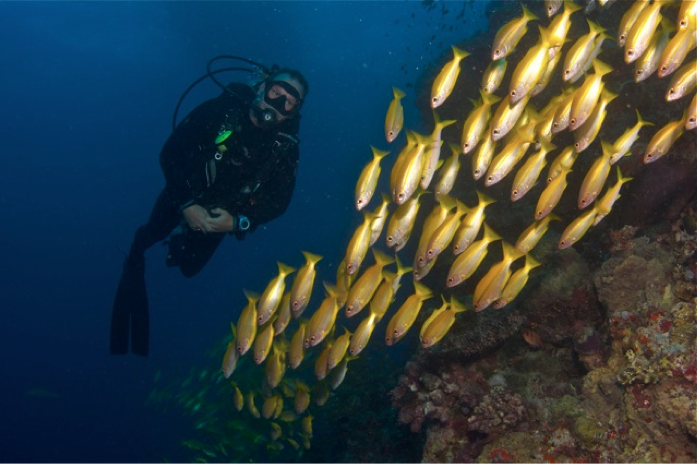
James in his element as a golden school dashes past.

James, in red, next to series presenter, the rather lovely ex-marine, Monty Halls.

An endangered sea turtle makes tracks towards the warm and equally in-peril Coral Sea.

Words, Daisy Dumas; images, courtesy of and many thanks to James Brickell at the BBC.

Standard
Portfolio

Sydney’s best kangaroo, CNN // 1 June 2011

Such is the Australian cultural peculiarity that the kangaroo not only adorns the national emblem and TV shows, but also dinner plates across Sydney.

Lean, healthy and apparently beneficial as the meat may be, it’s probably not surprising that it is tainted with “Skippy Syndrome” — a public sympathy for not wanting to devour Joey’s mum.

But it’s versatile, good value and has the added kudos of being entirely free-range, unfarmed, methane-free and sustainably managed. It tastes pretty good, too.

On whichever side of the fence you hop, here are five takes on a plate of ‘roo in Sydney.

Char-grilled ‘roo at Blackbird Café

Kangaroo

Char-grilled kangaroo and steamed veggies at Blackbird is a healthy choice.

OK, it’s not going to win awards for originality, but where else can you depend on finding a char-grilled tender kangaroo loin glazed in chef’s special orange marmalade sauce ($29.90) at any time of the week?

It helps that the ‘roo in question is perfectly cooked and paired with steamed veggies, making it tip-top in the healthy stakes.

On account of its low fat content, kangaroo’s not the easiest of meats to master, becoming easily overcooked or tough, so Blackbird’s spot-on loin is a rare find: the pink meat and bloody juices adding umami-laden depth to the sweet citrus sauce.

It’s a generous portion, so bag a window seat and let your meal go down whilst watching the world — and tourist boats — go by.

Blackbird Café, Balcony level, Cockle Bay Wharf, Darling Harbour, +61 (0)2 9283 7385, 8 a.m.–11 p.m. daily.

‘Roo pizza at the Australian Hotel

Kangaroo

The fair dinkum kangaroo pizza at the Australian Hotel.

No quibbling over this one –- get to The Rocks and tuck into a kangaroo pizza at the heritage-listed Australian Hotel, equipped with marble wash-rooms and an old-world feel.

A bastion of all things fair dinkum, there are more than 100 Aussie beers to choose from (no imports) so it may come as no shock that the kangaroo pizza ($25.90) is the most popular (and certainly least Italian) pizza on the menu.

Strips of meat are marinated in native mountain pepper and served with roasted capsicum, cranberries and lots of gooey cheese. Not the healthiest take on Skippy, but there aren’t many better ways to fill up whilst sampling the beers and wines amongst colonial charm.

The Australian Hotel, 100 Cumberland St., The Rocks, +61 (0)2 9247 2229, Sunday-Thursday 10:30 a.m.-midnight, Friday-Saturday 10:30 a.m.-1 a.m.

Raw or cooked ‘roo at Kingsley’s Steakhouse

Kangaroo

Carpaccio kangaroo for lovers of raw meat.

On a cold winter night, Kingsley’s cosy warmth hits the spot — old stone walls, low ceilings, exposed beams, wooden floorboards and immaculate service.

There’s an excellent take on the ‘roo fillet here — a worthy alternative to steak — served with onion and juniper jam and a mayo-free Italian coleslaw ($31.50).

Kingsley’s also serves the more unusual carpaccio with celeriac and horseradish remoulade ($17.50), which elevates raw Australian fare to a thing of elegance and sophistication. The wafer-thin, uncooked, translucent meat sits delicately alongside the rich, mayo-heavy remoulade.

Up the cosiness ante with a good red wine and again, ‘roo proves its value as a meat for dedicated carnivores –- best raw or cooked as little as possible.

Kingsley’s Steakhouse, 29A King St., City, +61 (0)2 9295 5080, Monday-Friday noon-3 p.m., 6 p.m.-10 p.m., Saturday 6 p.m.-10 p.m.

French ‘roo at Restaurant Paradox

Kangaroo

The steak tartare at Paradox is the French take on kangaroo.

Anachronistic, honest and good value, you can’t go wrong with a trip to Paradox in Crow’s Nest — especially if you’re after a taste of Cordon Bleu cookery. It’s not modern, glamorous or trendy, but what owner and chef Michel Delcour lacks in snootiness, he makes up for in flawless French food — and a firmly European take on ‘roo.

A kangaroo steak tartare is faultless – deliciously peppery, bright meat and plenty of punch from capers and shallot turn the boomer into an entrée of which Escoffier himself would be proud.

Kangaroo fillet with green peppercorn sauce is a pleasure, too. The sauce — usually paired with steak –- is rich and fiery and does well to cut through the subtle gaminess of cooked ‘roo. Bon appetit, mate.

Restaurant Paradox, 98 Falcon St., Crow’s Nest, +61 (0)2 9956 8898, Monday–Saturday 7 p.m.–late.

BYO, three courses $49.

Fillet of ‘roo with a view at the Clovelly Hotel

Kangaroo

A view of the fillet at the Clovelly Hotel — that comes with a view.

The pub with a decent view is a wonderful thing — and The Clovelly Hotel’s (or “Cloe”) view opens onto the ocean and rocky headlands of the eastern suburbs shoreline.

Thankfully, its food can stand up to the setting and their ‘roo dish ($26) is no exception. Great value posh pub grub it is — proven by the sliver of truffle topping my 200-gram kangaroo fillet.

Things are kept simple so that flavours aren’t hidden — choose a sauce from the list (the chef recommends parmesan aioli and gravy on the side and who are we to disagree?), and pair your posh kangaroo with a big bowl of hot chips and a cold beer. We’ll drink to that.

The Clovelly Hotel, 381 Clovelly Road, Clovelly, +61 (0)2 9665 1214, Monday-Friday 11 a.m.-midnight, Saturday 10 a.m.-midnight, Sunday 11 a.m.-10 p.m.

Or, read online at CNNGo.com

Standard
Portfolio

Formal millinery storms the US, Daily Mail NYC // 30 May 2011

My piece for Daily Mail NYC… (or read the piece with lots of pretty pictures at MailOnline)

The days of doffed caps and feather bonnets are long gone, but now a new breed of formal headwear is paving the way for a glamorously decorative barnet.

From the svelte form of a ribboned band or a more ebullient frothy plumage of colourful feathers, a fanciful dash of head bling is the ultimate cherry on top.

Blurring the boundaries of jewellery, hairdos and millinery, the playful eccentricity of statement millinery seems to have well and truly caught on in the U.S. too.

In the UK, hats and fascinators are most associated with the races – Ladies’ Day at Ascot, for example – and weddings, where headwear is often an unwritten part of the dress code.

Who could forget Princess Beatrice’s much-maligned ‘pretzel’ hat at the Royal Wedding, by top milliner Philip Treacy – or the criticism of British First Lady Samantha Cameron’s decision to attend in a jewelled Erdem hairpiece rather than a traditional hat.

But head ‘confectionery’ – as New York radio show host Bill Cunningham put it – is adorning all the most fashionable tresses in a revival he says New York hasn’t seen for 50 years.

Indeed, at this month’s Met Ball, a tribute to late fashion designer Alexander McQueen, A-list heads were encrusted, bejewelled and feathered.

And to SamCam’s credit, many a fashionista sported an upmarket hairclip.

Stella McCartney shone in a sophisticated waved headdress, Naomi Campbell wore a sparkling clip and Kate Hudson sported an Indian-inspired jewel on her crown.

Australian actress, Isabel Lucas, wore pearl and gold head jewellery by Lorraine Schwartz whilst a tiara-esque band sat atop the Black Eyed Peas’ Fergie’s mane.

Tennis player Serena Williams went for a Fifties-style white fascinator, while Yoko Ono wore a playful white veiled mini top hat by veteran milliner, Stephen Jones.

Laurie Kennard of Chicago-based milliners, Chapeau, told MailOnline: ‘There is an increase in “taking a hat chance”, you might say. Much younger women are attracted to hats… It’s not just the influence of the Royal Wedding.’

Chapeau has seen an increase in sales of late, which Ms Kennard says is part of a bigger change in tastes.

‘Perhaps after the supra-casualness that began in the late Sixties, women are craving elegance,’ she continued. ‘Or it could be that when you are in your twenties and your mother’s era looks stodgy, your grandmother’s era looks elegant.

‘Today’s young women would then be looking to the 1950s and early sixties for inspiration, definitely a time of more elegance.’

Of course headdresses are nothing new. The trend harks to the eccentricity of the heady (sorry) pre-WWII days of Paris-based designer Elsa Schiaparelli. Hailed as being ahead of their time, her hats included an upturned high-heeled shoe and many a feather-adorned turban.

Turbans had their heyday in the 1920s, resurfaced in the 70s and are once again back in vogue – Salma Hayek and Nicole Scherzinger have both managed to pull off the look to great effect.

But where once some get-ups were made to stay private, there are some adventurous public airings of previously stay-at-home looks.

Swimming caps – objects of dread from embarrassing school swimming lessons – are coming out of the closet once again, with new designs good enough to be seen in on the beach, particularly matched with on-trend retro swimwear.

And who would have thought the Queen would boldly step out in a (rather fancy) hairnet?

At last week’s Chelsea Flower Show, Her Royal Highness sported a black hairnet adorned with small black bows. There’s no question that we’re all more used to something a little more regal – a crown, say – nestling amongst her grey curls, and the hairnet-with-a-twist was a rare moment of fashion daring.

One onlooker joked that she should ‘sell the offending article on eBay and have the milliner sent to the Tower.’

The Tower is unlikely, given that the ensemble was apparently designed by the Queen’s in-house fashion team at Buckingham Palace. The ‘pragmatic choice’ was in preparation for any unwelcome gusts of wind – perhaps a precautionary reaction to Michella Obama’s flyaway hair which fell victim to Dublin’s inclement windy weather on her recent state visit.

Whether it will catch on, a la the fashionable hairnets of the Forties, is anyone’s guess – suffice to say, a sparkly hairclip or fanciful hat is a more on-trend option for now.

Marissa Vitano of Bloomingdales told MailOnline that ‘hats are the must have accessories this season.’

We have no word, so far, on the sales of designer hairnets.

Standard